
 EN
EN



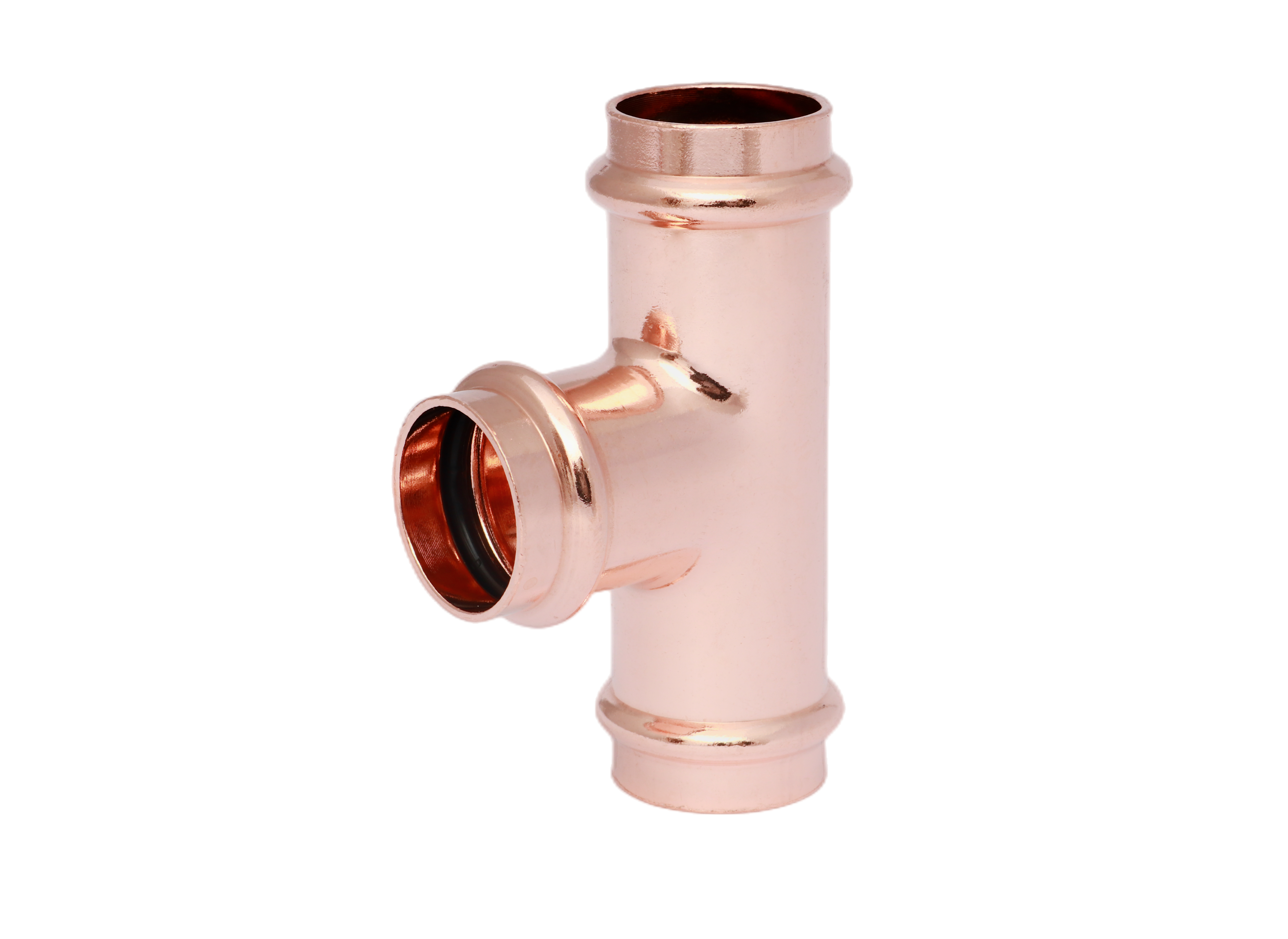
Understanding Flame-Free Claims: How Copper Press Fitting Eliminates Ignition Sources
The physics of cold joining: no open flame, spark, or hot surface generation
Copper press fitting creates a permanent joint through cold mechanical deformation—not heat. A specialized pressing tool applies thousands of pounds of force to compress the fitting around the pipe, uniformly squeezing an elastomeric O-ring (typically EPDM or HNBR) into a dovetail groove to form a resilient, leak-tight seal. Because the process requires no solder, flux, or open flame, it eliminates the primary ignition sources inherent in traditional soldering. The pipe and fitting remain at ambient temperature throughout—no hot work is generated, no sparks fly, and no glowing surfaces exist. Even battery-powered tools engage their motors only momentarily, with heat-producing components fully enclosed and isolated from the joint. This purely mechanical union significantly reduces fire risk during installation and makes the method intrinsically safer for occupied or sensitive buildings.
Key limitations: battery thermal runaway, tool malfunction, and static discharge in volatile atmospheres
While the press joint itself introduces no heat or flame, the enabling equipment can pose rare—but critical—hazards. Lithium-ion battery packs powering modern pressing tools are susceptible to thermal runaway if damaged, overcharged, or exposed to extreme temperatures, potentially causing fire or explosion adjacent to—not from—the joint. Tool malfunctions—such as gear seizure, electrical short circuits, or metal-on-metal impact during crimping—may generate brief sparks or hot debris. In environments with oxygen enrichment, hydrocarbon vapors, or combustible dusts, even minor discharges from motor brushes or static buildup on plastic housings could ignite a volatile atmosphere. Operators must therefore verify tool integrity, follow antistatic protocols, and, where required, use intrinsically safe equipment per NFPA 497 and 70E. Though copper press fitting dramatically reduces ignition risk compared to open-flame methods, it does not eliminate all hazards—comprehensive safety assessment remains essential in classified or high-risk locations.
Copper Press Fitting Safety in Confined and Sensitive Environments
Real-world validation: hospital, lab, and data center retrofits with zero hot work permits
Hospital retrofits, analytical labs, and data centers demand uninterrupted operations and stringent fire safety controls—and copper press fitting has proven its value by eliminating ignition risks entirely during pipe joining. A 2022 case series documented over 200 mechanical room upgrades in active hospitals where no hot work permits were required; jurisdictional fire marshals recognized the process as inherently safe. Without flame or heat, press fitting avoids igniting nearby medical gas lines, volatile chemical storage, or live server racks. In one laboratory renovation, a leading manufacturer’s press system joined copper piping while autoclaves and fume hoods operated continuously just meters away—an outcome impossible with soldering. Similarly, data center technicians install cooling loops in live server aisles without powering down equipment. Over three years, a facilities management consortium recorded zero fire events across 1,200 press-fitting projects in commercial interiors (Facility Safety Report, 2023). By removing open flame and hot surfaces, press fitting transforms formerly high-risk zones into routine maintenance areas.
When caution remains essential: oxygen-enriched, hydrocarbon-contaminated, or combustible-dust environments
Despite its cold-joining nature, copper press fitting does not render all hazardous locations unconditionally safe. In oxygen-enriched atmospheres, even small sparks from tool operation or static discharge can violently ignite non-metallic materials. Hydrocarbon-contaminated pipework—common in refineries or fuel storage—may retain flammable vapors that a compromised battery or dropped fitting could ignite. Combustible dust environments, such as grain mills or wood processing plants, add further complexity: airborne particles can settle on equipment and flash over if a tool overheats or malfunctions. A lithium-ion battery in thermal runaway releases intense heat without external flame—making gas testing, purging, and continuous monitoring mandatory per NFPA 70E and 497. While the fitting process itself is flame-free, the surrounding conditions and equipment must still be rigorously assessed. A single oversight—a tool strike creating a spark in a fuel-rich zone—can negate the safety benefit. Risk assessments must therefore extend beyond the joining method to encompass the full work environment.
Copper Press Fitting vs. Soldering: Measurable Fire Risk Reduction in Tight-Space Applications
NFPA 51B and field data: 92% fewer fire incidents when replacing soldering with copper press fitting in commercial interiors
The fire prevention advantage of copper press fitting in confined commercial interiors is empirically validated—not speculative. NFPA 51B mandates strict controls for hot work, including fire watches and 35-foot clearance sweeps of combustibles before any open flame is used. Field data synthesized from multiple property loss prevention reports shows that facilities adopting mechanical joining systems instead of torch-based methods experienced 92% fewer fire incidents during piping modifications (Fire Protection Research Foundation, 2021). The root cause is direct: removing the ignition source breaks the chain of events that leads to smoldering insulation or delayed pyrolytic combustion inside wall cavities. Installers using battery-powered pressing tools require clearance only for the tool jaw—not a controlled hot zone—eliminating the need for formal hot work permits in many jurisdictions and accelerating project timelines in sensitive occupancies like hospitals and schools.
Eliminating hidden hazards: flux vapors, radiant heat, and structural thermal transfer unique to soldering
Copper press fitting eliminates a triad of hidden hazards associated with soldering in tight spaces—hazards that complicate risk management beyond visible flame control. First, petroleum-based fluxes release corrosive vapors when heated, posing respiratory risks in poorly ventilated closets or service shafts. Second, radiant heat and conductive thermal transfer create a hazardous thermal halo: copper pipe can exceed 400°F several feet from the flame, igniting concealed wood framing or melting wire insulation on the opposite side of a wall—a common finding in fire investigations. Third, post-soldering cooling is passive and uncontrolled; a press joint reaches ambient temperature immediately, eliminating the risk of heat-soaked joints smoldering against cellulose insulation after the installer departs.
FAQ Section
What is copper press fitting?
Copper press fitting is a method of joining pipes through cold mechanical deformation using specialized pressing tools, eliminating the need for solder, flux, or open flame.
How does copper press fitting reduce fire risks?
It eliminates ignition sources like open flames, sparks, and hot surfaces, making installations safer in sensitive or occupied buildings.
Are there any limitations or risks associated with copper press fitting?
Though intrinsically safer, risks like lithium-ion battery thermal runaway, tool malfunctions, and static discharge in volatile environments must still be managed.
Where is copper press fitting especially beneficial?
It is highly beneficial in confined and sensitive environments such as hospitals, laboratories, and data centers where fire safety is paramount.
How does copper press fitting compare to soldering?
Copper press fitting reduces fire risks by 92% compared to soldering in commercial interiors and eliminates hazards like flux vapors and radiant heat unique to soldering.