EN
EN



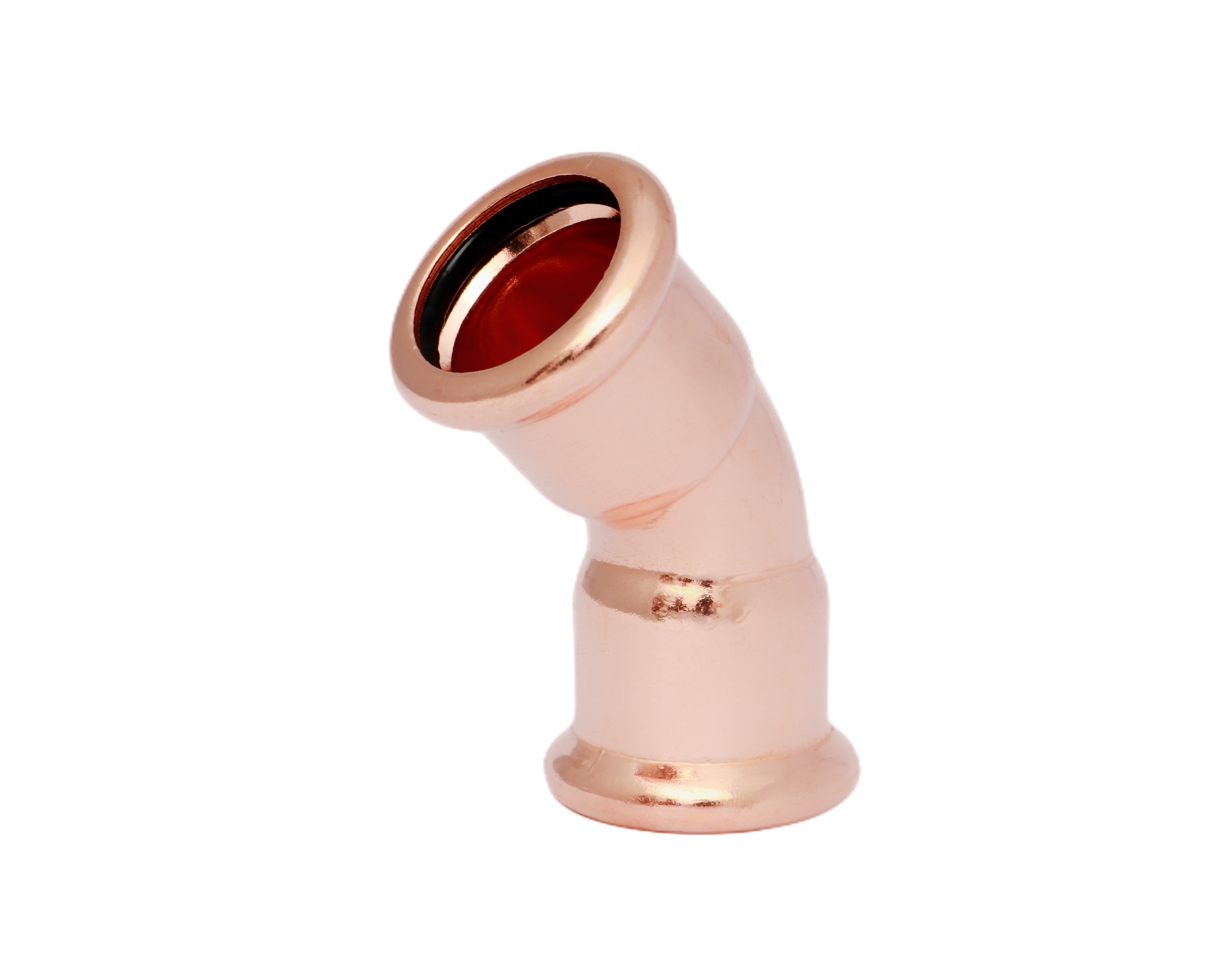
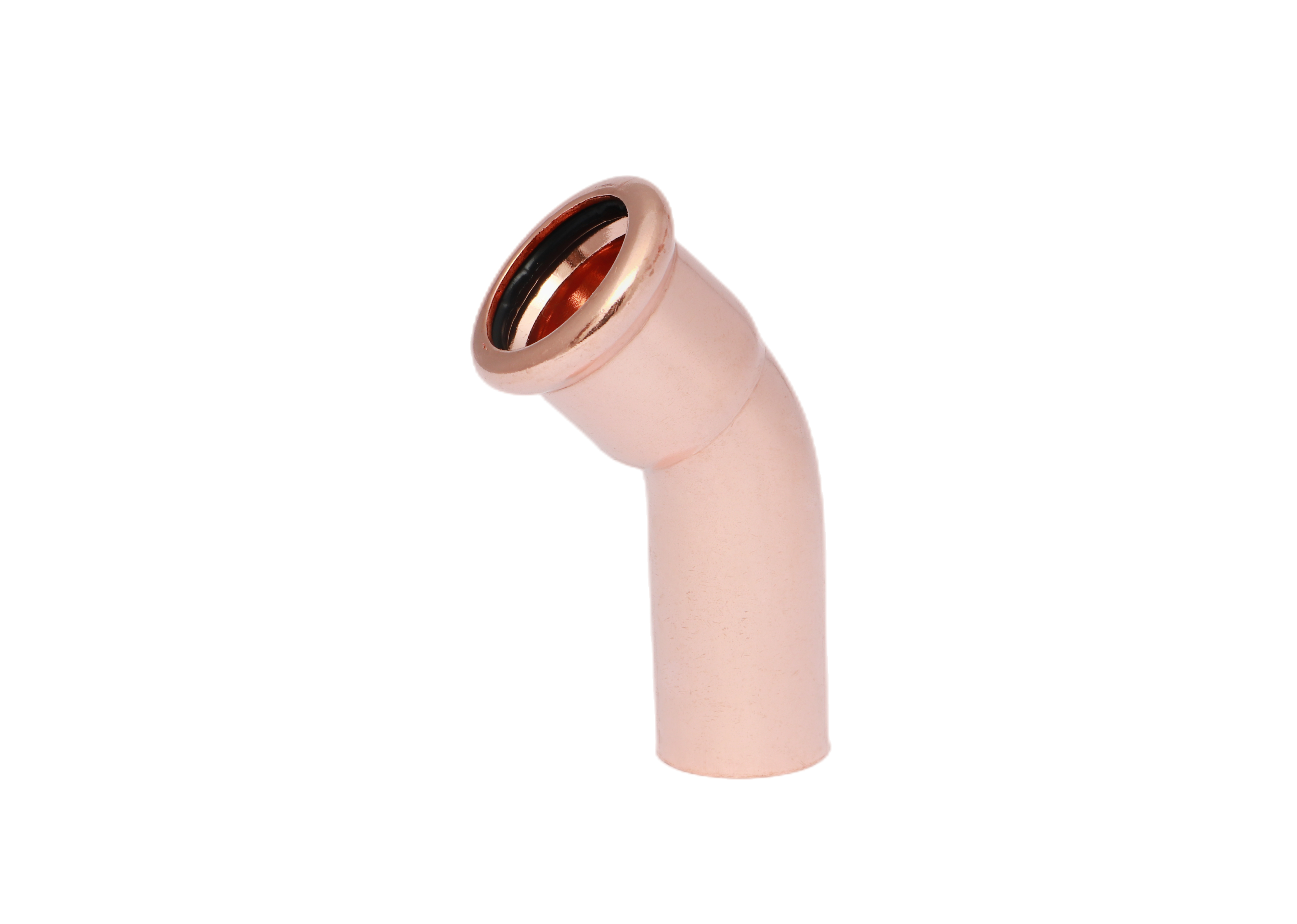
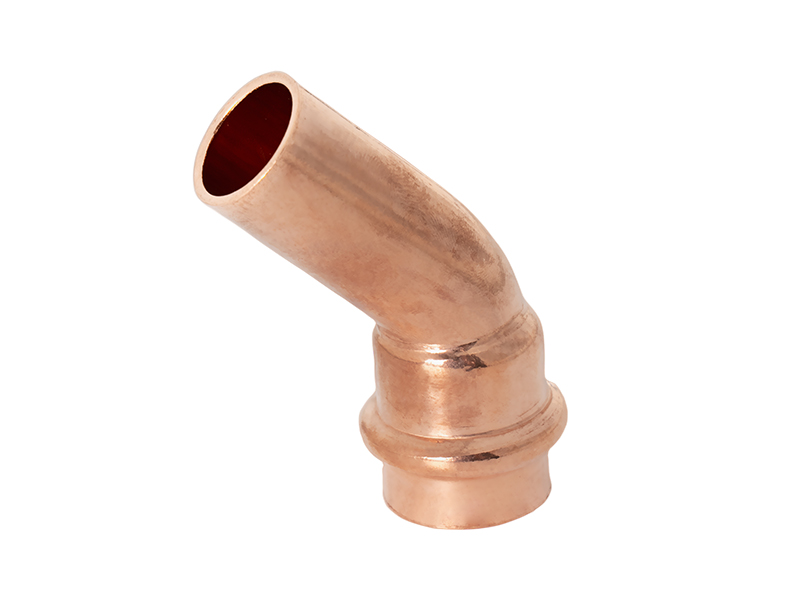
Copper press fitting with M profile-45° elbow cxc
Discover our high-performance copper press fittings for reliable plumbing and piping. Our press connection system offers fast, leak-proof installation for copper tubes in water, heating, and air applications. View technical specs and dimensions.
-Material: Copper Alloy (CW602N)
-Sealing Element : EPDM O-ring
-Certifications : WRAS Approved
- Overview
- Recommended Products
Overview
Copper press fittings are a next-generation piping connection solution developed to meet the demands of modern construction, where speed, safety, and installation consistency are critical. Unlike traditional soldered joints, this system uses a cold-press mechanical method that allows copper tubes to be joined quickly without heat, flux, or open flame, significantly simplifying on-site operations.
At the core of the system is a precision-engineered fitting body combined with a high-performance sealing element, typically an EPDM O-ring. When the press tool is applied, the fitting is permanently compressed around the inserted pipe, creating a uniform mechanical bond. This process ensures both structural strength and a tight hydraulic seal, reducing the risk of leakage even under long-term pressure and vibration conditions.
From a functional perspective, copper press fittings can be viewed as a complete installation system rather than just a connector. It integrates three essential elements: accurately manufactured fittings, standardized copper tubing, and dedicated pressing tools. When used together, they form a streamlined workflow that eliminates many of the variables associated with traditional hot-work installation methods.
In terms of application scope, the system supports multiple engineering environments. It is widely used in potable water distribution systems where hygiene and reliability are essential. In hydronic heating networks, it ensures stable thermal circulation and efficient energy transfer. It is also suitable for chilled water systems used in HVAC installations, as well as compressed air lines in industrial facilities where airtight performance is required.
One of the most important advantages of this technology is the improvement in job site efficiency and safety. Because no soldering or flame-based work is required, installation can proceed without hot work permits, reducing regulatory constraints and fire hazards. This makes it particularly suitable for renovation projects and occupied buildings.
Overall, copper press fittings redefine traditional piping installation by combining speed, safety, and durability into a unified, highly efficient connection method.
Key Features & Benefits
1. Installation Efficiency (Rapid Installation)
Copper press fittings are designed for high-speed assembly, allowing each joint to be completed in less than 10 seconds using a compatible pressing tool. This dramatically shortens installation cycles on-site, improves workflow efficiency, and reduces overall labor demand. For large-scale piping projects, this time-saving benefit translates directly into higher productivity and faster project completion.
2. Safety Performance (Flame-Free & Safe)
The system operates without soldering, brazing, or any form of open flame. As a result, there is no requirement for hot work permits, which simplifies site management and compliance procedures. This flame-free method significantly reduces fire hazards and allows installation in sensitive environments such as hospitals, schools, commercial buildings, and occupied residential spaces where safety restrictions are strict.
3. Connection Reliability (Leak-Proof Integrity)
Each press connection forms a mechanically locked and permanently sealed joint. The design ensures strong resistance to vibration, pressure fluctuations, and thermal expansion. Once installed, the joint maintains stable performance over long service periods, minimizing the risk of leakage and reducing maintenance requirements throughout the system lifecycle.
4. Material Compatibility (Versatile Application)
Copper press fittings are suitable for both hard-drawn (rigid) and soft (annealed) copper tubes. They are manufactured in compliance with internationally recognized standards such as ASTM B88 and EN 1057, ensuring consistent quality and compatibility across a wide range of plumbing and HVAC applications.
5. Economic Efficiency (Cost-Effective Solution)
By eliminating hot work procedures, reducing installation time, and minimizing safety-related insurance and downtime costs, the system significantly lowers total project expenditure. It also reduces labor intensity and improves construction scheduling efficiency, making it a cost-effective choice for modern piping infrastructure projects.
Technical Specifications
Parameter |
Specification |
Material |
Copper Alloy (CW602N) |
Sealing Element |
EPDM O-ring |
Sealing Material Temp. Range |
-20°C to +110°C |
Operating Pressure |
Max 16 Bar |
Standards |
AS3688,EN1057 |
Size Range |
15mm-54mm |
Certifications |
WRAS Approved |
Connection Method |
Cold press using a calibrated jaw tool |
Installation Guide
Step 1 — CUT (Precision Preparation)
Begin by cutting the copper tube using a professional tube cutter. Ensure the cut is perfectly square to achieve optimal alignment inside the fitting. A clean and accurate cut is essential for maintaining sealing integrity and preventing uneven stress during installation.
Step 2 — DEBURR (Edge Refinement)
After cutting, carefully remove all internal and external burrs. This step is critical because any sharp edges or metal fragments can damage the internal O-ring or obstruct proper pipe insertion. A smooth tube end guarantees a secure and reliable sealing surface.
Step 3 — MARK (Depth Control)
Measure and mark the required insertion depth on the outside of the tube. This reference line serves as a visual guide during installation, ensuring the pipe is fully inserted into the fitting body before pressing begins.
Step 4 — INSERT (Proper Engagement)
Push the copper tube straight into the press fitting until it reaches the internal stop. Full insertion ensures correct positioning of the pipe within the sealing zone and prepares the joint for compression.
Step 5 — PRESS (Mechanical Connection)
Position the press tool jaws accurately over the fitting. Activate the tool to apply controlled radial force. This permanently compresses the fitting around the pipe, forming a strong mechanical lock and activating the sealing system for a leak-resistant connection.
Step 6 — VERIFY (Quality Confirmation)
After pressing, inspect the joint carefully. Most fittings include a built-in visual indicator, such as a hexagonal deformation pattern, which confirms that the press operation has been completed successfully. This final check ensures installation quality and system reliability before commissioning.
This structured workflow ensures every connection is completed with precision, safety, and long-term performance in mind, making copper press fittings a dependable solution for modern piping systems.